

Anderson Ranch - Snowmass, CO
 Odyssey Center - Asheville, NC
 Canton Clayworks - Canton, CT
An excerpt from my talk for the Evolving Role of Residencies panel. I will be joining Martina Lantin, Jill Oberman, and Cynthia Consentino to talk about our experiences and observations. For my part I will cover the residency as a form of business education. I open by contrasting observational and curriculum-based learning styles. My time as a resident helped solidify the way I approach learning in my own studio life. If you are in Seattle stop by and join the discussion. Seattle Design Center Ballroom 6C Thursday 2:30-4
Through study at a four year academic institution I learned art history, aesthetics, and technique. These tools were essential to my foundation as an artist, but without real world application they remained intellectual pursuits. It was not until I left the academic cocoon that these tools attained their practical value. The transition from the safety of the institution to the realities of artistic self sufficiency was a jarring experience. Whereas ideas are the currency of academia, cash is the currency of the real world. Turning ideas into cash is a challenge that was both overwhelming and confusing. To help smooth my transition from student to artist I chose to participate in both short and long term residencies. These communities offered the advantages of shared costs, interaction with other artists, and access to established networks of patrons.
The switch from academia to the residency system involved a switch from curriculum-based learning to observational learning. By default curriculum-based learning has a defined form. Within this form the teacher externally motivates the student by assigning problem solving tasks that progress in a linear direction. After completing the curriculum the student has attained the knowledge embedded in the assignment. This style of education is one size fits all. It can be spread over large groups of people to standardize the quality of education while maximizing the quantity of learners.

(Diagram A: Curriculum-based Learning)
In contrast observational learning is self-directed and unique to each learner. For me this starts when I experience an idea or object I cannot easily understand. My lack of understanding feels like an intellectual itch that I have to scratch. To satisfy my curiosity I work backwards from solution to question in an attempt to reverse engineer the understanding that I am seeking. It is an intuitive process that involves lots of wandering and mistake-driven redirection.

(Diagram B: Observational Learning)
I have found it helpful to give a loose form to this non-linear process, which shares many similarities with the scientific method. First a catalyst for observation is chosen. This might be the intricate patterns of a historical piece of pottery or another artist’s explanation of their aesthetic. With my interest piqued I search for any information on the subject. I might ask my fellow resident artists, or if no personal connection can be made I head to the internet for information. Armed with a breadth of knowledge I test different research paths hoping to find one that will yield a repeatable process. This style of learning is not efficient in terms of time but it creates a comprehensive understanding of the subject.
Observation does not guarantee understanding but it allows the learner to choose the form learning will take. This freedom of choice is empowering, leaving the full responsibility of inquiry on the shoulders of the learner. When an individual has taken ownership of their learning unexpected and exciting discoveries can happen. This style of learning has continued beyond and throughout my formal education. As I re-evaluate my knowledge base I see the reciprocal nature of both curriculum-based and observational learning. After participating in three residencies where I learned mostly by observation I went back to graduate school. Re-entering the academic environment with a more developed sense of observation served me well. I was able to approach curriculum-based learning with an engaged perspective that helped me yield more information from the assignments I was given.


 Even with our similarities I see many differences between the Anangu approach to art and my own. This project is about exploring these differences and learning from them. One main difference is the role art making plays in the community. It is a central component of story telling which extends and strengthens their culture. This essential role excites my curiosity because the culture is not large in number. While the human impact of American culture numbers in the millions, Anangu culture can be measured in the thousands. The town I will be living in has around 500 members and this is a relatively large settlement for a group that transitioned away from a nomadic lifestyle within the last hundred years. The role their stories, music and art play in protecting their heritage are of great interest to me.
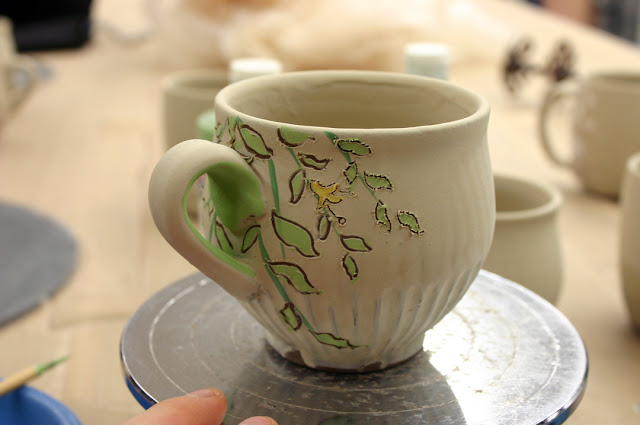 Here is the mug after decoration. I filled the handle side with a dense honeysuckle pattern. The opposite side was left undecorated leaving a large open wide space.


